Resource Center/Article • 09/22/2025
FedEx’s 2026 General Rate Increase (GRI) Is In – How Shippers Can Prepare
FedEx has released its 2026 service guide, outlining rate changes in the annual General Rate Increase (GRI) that set contract discount baselines.

Ted Jackson
Strategic Solutions Manager

Ted Jackson is a Solutions Manager at Green Mountain, a Parcel Spend Management service provider for the largest shippers in North America. In this role, Ted partners with clients and internal Green Mountain teams to provide a parcel rate audit, customized reporting, network optimization, and carrier contract management. Ted has been at Green Mountain for […]
Since carriers first began publishing annual GRIs, the increases have been less about the percentage itself and more about how those changes compound over time. FedEx’s newly released 2026 service guide reflects that ongoing trend. The announced 5.9% base rate increase may be expected, but the more significant changes are found in how surcharges are defined, thresholds are reset, and zone structures are applied. For shippers managing complex networks, understanding this evolving landscape is critical to balancing cost discipline with customer expectations.
Evolving Cost Components
While the GRI is often framed around a single percentage, parcel spend is shaped by three primary cost components:
- base freight
- surcharges
- fuel
Fuel is outside the scope of this discussion as fuel index changes are generally infrequent and not directly aligned to the GRI. However, in recent years, index increases for all carriers can be characterized as distinctly non-infrequent.
FedEx has announced an increase of 5.9% on base freight list rates, which is in line with the last few years but higher than the historical 4.9%. List rates are published for each service by billed weight and zone. This makes up the lion’s share of the package cost, although it has decreased as a percentage of total cost in recent years as surcharge and fuel increases have outpaced it.
Many large shippers’ contracts have rate caps on their base freight increase, which provides the maximum increase for the specified service. Shippers will want to verify that the resultant increase is within any specified rate cap.
Rising Surcharges
Carriers have been aggressively increasing surcharges rates in recent years. The following table highlights the more common surcharges and the ranges of their increases in 2026.
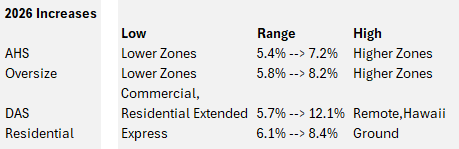
While this is not a record year for increases, it shows FedEx’s tendency to increase surcharges more aggressively, which are less frequently protected by rate caps.
Carriers are also adjusting the thresholds as of late, which increases the occurrences of surcharges and/or modifies the rate structure. Historical examples include:
- the addition of the length plus girth threshold for Additional Handling surcharges (AHS)
- changes to dimension or weight thresholds for AHS or Oversize
- the addition of zone-based rating structures
Turning Increases into Predictability
Shippers can prepare for 2026 by validating rate increases fall within any contractual caps. List rate increases are not evenly distributed amongst weight bands, zones, or even services, so shippers will need to validate at a more granular level. Any surcharges that have rate caps will need to be validated as well. If any rates fall outside of the caps, then shippers will need to work with their FedEx partners to ensure everything is in order before the 2026 rate increases go into effect. Having a thorough understanding of the variance and what is driving it goes a long way in communicating the issue to FedEx.
Even with the inevitability of rising GRIs, maintaining control over your transportation spend is achievable. Our data demonstrates that with the right approach and support, shippers can maintain a strict budget discipline even as GRIs escalate.
75% of our customers report their actual transportation costs are within +/-5% of their budget. In fact, 95% were either under budget or no more than 5% over. These figures are in stark contrast to the non-customer group, where 63% of shippers surveyed were significantly over budget. At Green Mountain, we help large, complex shippers gain more value from their networks and maintain control of their transportation spend. Discover how we’re raising the shipping standard.
Share this page:
Success with a proven process